


Legal Interpretation in Joint Operation Business
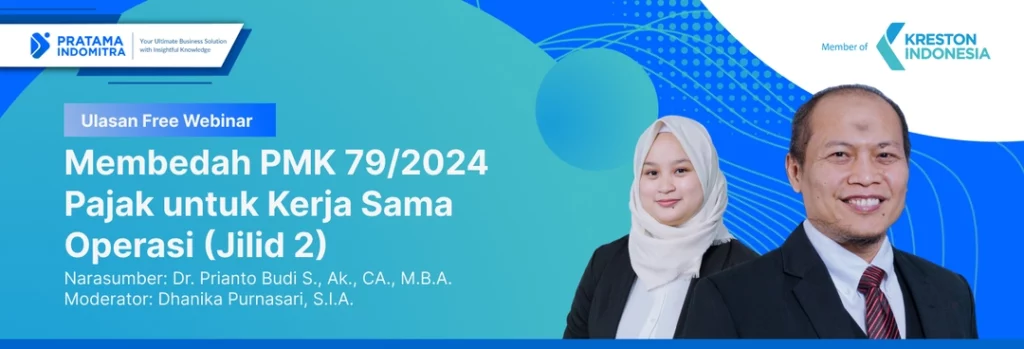
PT Pratama Indomitra Konsultan presented its 180th Free Webinar, a continuation of the previous webinar. The webinar was held on Wednesday, December 4, 2024, with the keynote speaker being Dr. Prianto Budi Saptono, Ak., CA., M.B.A., an experienced practitioner, academic, researcher, and CEO of PT Pratama Indomitra Konsultan.
In this 180th webinar, Dr. Prianto presented a question-and-answer session on joint operation business as regulated by Minister of Finance Regulation No. 79/2024, providing firsthand insights from a tax practitioner’s perspective. The webinar was moderated by Dhanika Purnasari, S.I.A., a tax consultant at PT Pratama Indomitra Konsultan, to ensure an interactive and informative discussion.
Dr. Prianto opened the webinar by providing his approach to addressing various issues in the field, including questions raised by webinar participants. In answering questions regarding joint operations (KSO), one approach presented is to provide legal certainty through the interpretation of relevant regulations. The complexity of legal regulations often gives rise to honest confusion due to the numerous articles that need to be understood. Therefore, it is crucial for the parties involved to understand the intricacies of KSO law in order to take appropriate steps.
According to Mr. Prianto, a thorough understanding of the legal subjects and objects in a transaction is fundamental. Legal subjects refer to the parties involved, such as individuals or business entities, while legal objects relate to what is agreed upon, including KSO transactions, such as whether the transaction is taxable or not.
In explaining issues related to KSOs, Mr. Prianto emphasized the importance of understanding the law through an interpretive approach, or rechtvinding. One step is to review whether the title of the contract matches the content of the agreement, as such discrepancies can lead to ambiguity. For example, an unclearly defined cooperation contract can create gaps in multiple interpretations, resulting in differing understandings between the parties involved. Therefore, legal interpretation is key to ensuring that the agreement reflects the true intent and objectives of the parties.
Furthermore, he emphasized the importance of designing a Joint Operation (KSO) contract from the outset, paying attention to the details of the transaction. Contracts need to be well-drafted to prevent potential multiple interpretations of regulations and anticipate potential tax issues. In this regard, each KSO transaction must be clearly translated into its contractual basis, thus providing solid guidelines for tax implementation and reporting. With this approach, business actors can conduct KSO business activities more legally secure and in accordance with applicable regulations.
Legal Interpretation (rechtvinding)
The rechtvinding approach, or legal discovery, is carried out in two ways. First, by understanding the rules in contract law that govern the rights and obligations of each party in a transaction. Second, by interpreting public law regulations, such as tax law and other public law norms related to the case.
After these two interpretative steps are completed, a legal decision is then made. This decision aims to “revive” previously dormant law so that it can be applied to a specific case. In this way, the law can be used to resolve real-world problems while ensuring that decisions are made in accordance with existing regulations and the principle of fairness.
In the context of joint venture business, the legal basis in question is PSAK 66 for joint venture transactions effective before 2024 or PSAK 111 for joint venture transactions effective since 2024, as well as Minister of Finance Regulation No. 79/2024. Referring to PSAK 66/111, joint venture business consists of three activities:
An entity determines the type of joint arrangement in which it is involved. The classification of a joint arrangement as a joint operation or a joint venture depends on the rights and obligations of the parties to the arrangement.
A joint operation is a joint arrangement under which the parties having joint control of the arrangement have rights to the assets and obligations for the liabilities associated with the arrangement. These parties are called joint operators.
A joint venture is a joint arrangement under which the parties having joint control of the arrangement have rights to the net assets of the arrangement. These parties are called joint venturers.
Meanwhile, referring to Article 1 of PMK No. 79/2024, a Joint Operation (KSO) is a body in the form of a joint arrangement between members of a joint operation, which stipulates that the members of the joint operation have joint control or rights to assets and obligations.
Based on the two provisions above, there is a similarity between the business forms: a Joint Operation (KSO) is a form of joint arrangement. Joint control means that strategic or operational decisions regarding the KSO must be mutually agreed upon by all parties involved. No single party has full authority over the KSO arrangement.
According to the interpretation of Minister of Finance Regulation No. 79/2024, KSO members are responsible for ensuring that each transaction or obligation complies with the contribution or proportion specified in the KSO agreement. This provision provides flexibility in KSO arrangements, whether in the form of joint operations or joint ventures, depending on the agreement of the parties.
In closing the 180th webinar, Dr. Prianto explained that interpreting regulations is essential, especially in KSO business activities. Parties intending to collaborate and form a KSO should first draft a contract to minimize the potential for multiple interpretations later.
Pratam’s friends can download the materials and case studies from the 180th Free Webinar at the following link: