


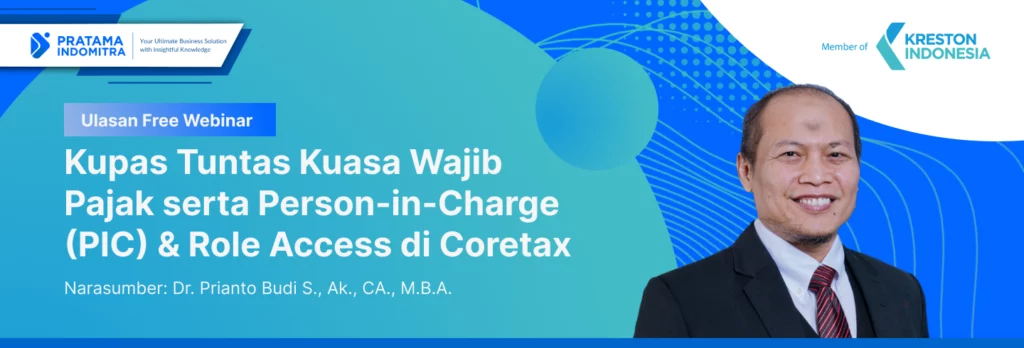
PT Pratama Indomitra Konsultan once again held the 185th Free Webinar discussing Taxpayer Power of Attorney and Person-in-Charge (PIC) & Role Access in Coretax. This webinar took place on Wednesday, February 5, 2025, with the main speaker Dr. Prianto Budi Saptono, Ak., CA., M.B.A., a tax practitioner, academic, researcher, and CEO of PT Pratama Indomitra Konsultan.
In this webinar session, Dr. Prianto provided a comprehensive explanation regarding the experiences of Taxpayers in accessing Coretax, which is known that CTAS has been effectively operating since January 1, 2025. In addition, he also reviewed the position & role of Taxpayer power of attorney in Coretax as one of the hot topics discussed among Taxpayers when fulfilling their tax rights and obligations through Coretax. This webinar was guided by Ms. Sri Hilda, who currently has the opportunity to do an internship as a staff in the Tax Compliance Division at PT Pratama Indomitra Konsultan.
Since early January 2025, the Coretax problem has shifted. Initially, the debate revolved around the programming language used in Coretax and the unclear legal language in PMK 81/2024 which is the basis for its regulation. However, now the more dominant problem is the extent to which Taxpayers understand and have the technical skills to use the new technology applied in Coretax.
One of the main issues that has emerged is the implementation of the impersonating concept in the Coretax system, which is closely related to the role access regulation. In this scheme, tax rights and obligations are carried out through an impersonating mechanism, namely the Coretax account of a body or individual with a representative can only be operated by an administrator, representative, or proxy who has been officially appointed.
Before Coretax was implemented, access to the corporate Taxpayer account was much looser. Anyone who knows the username and password can access it easily, without any restrictions based on status as an administrator or official proxy. Now, with the impersonating concept, only authorized individuals can run the account.
However, the implementation of this system raises new challenges. Taxpayers’ unpreparedness in understanding the Coretax programming language and their limited technical skills in operating this system are the main obstacles. One question that often arises is, to what extent do authorized individuals have access to data that is considered confidential by Taxpayers? This concern shows that although the Coretax system is designed to improve security and compliance, there are still gaps in user understanding and readiness in facing this technological change.
The Role of Consultants
In the webinar presented by Dr. Prianto, the important role of the Core Tax Administration System (CTAS) as a supporter of information technology in tax reform was discussed. On the other hand, tax regulations serve as a legal basis to ensure certainty and fairness in tax collection. Although both are designed to complement each other, their implementation often faces challenges, especially in integrating business processes that were previously carried out manually into technology-based systems.
Referring to the book Tax Law Design and Drafting (1998) by Thuronyi & Vanistendael, it is stated that the effectiveness of the tax system is highly dependent on the existence of tax consultants. This is due to the complexity of tax regulations that are difficult for most Taxpayers to understand. In this context, tax consultants have a crucial role in helping Taxpayers fulfill their often complicated tax obligations. By providing advice and guidance, tax consultants not only serve the interests of their clients but also contribute to improving overall tax compliance.
Despite having a strategic role in supporting the tax system, the primary loyalty of tax consultants remains to their clients, not to the state. This difference in roles creates an ethical dilemma and challenges in maintaining a balance between the personal interests of Taxpayers and the public interest in the tax system.
Regarding the problems that arise in the Coretax system, the resolution is entirely the responsibility of the Directorate General of Taxes (DGT) as the system developer. Moreover, not all DGT employees have the authority to provide solutions to problems in Coretax, and only the Coretax development team has the authority to handle these technical obstacles. Problem solving can be done in two main forms, namely: fixing the Coretax system if the problem is related to the programming language, or providing more technical guides that discuss the problem topic specifically. In the future, it is likely that technical guides will continue to be developed to make it easier for Taxpayers to understand the use of Coretax in general.
In terms of regulation, Indonesia implements a full regulation model, but its regulations are not entirely regulated at the statutory level. In accordance with Article 7 and Article 8 of Law No. 12 of 2011 concerning the Formation of Legislation, some of the regulations are in the realm of technical regulations. Meanwhile, Article 44E of the KUP Law gives the Minister of Finance the authority to regulate the Taxpayer’s power of attorney technically and administratively through ministerial regulations.
In closing, Dr. Prianto summarized the webinar material by explaining the role of the Taxpayer’s representative/proxy in CTAS. In this system, there are 11 types of documents that can be worked on by the Taxpayer’s representative/proxy, including as drafter and assigner of the PPh SPT document. The role of assigner is specifically intended for the Taxpayer’s proxy, while the role of drafter is given to the Taxpayer’s PIC to prepare the necessary documents
Pratama Friends can download the material and case study of the 185th Free Webinar at the following link