


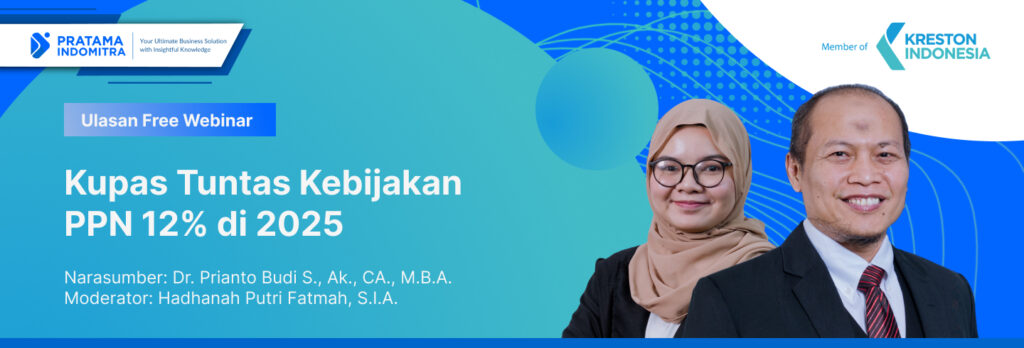
PT Pratama Indomitra Konsultan is back with the 181st Free Webinar which discusses in depth the issue of increasing Value Added Tax (VAT) from 11% to 12%. The increase is planned to be implemented starting January 1, 2025. This webinar will be held on Wednesday, December 18, 2024, with the main speaker Dr. Prianto Budi Saptono, Ak., CA., M.B.A., an experienced practitioner as well as an academic, researcher, and CEO of PT Pratama Indomitra Konsultan.
In this session, Dr. Prianto discusses in depth the VAT provisions stipulated in the 2021 HPP Law along with its derivative regulations. In this webinar, Dr. Prianto tries to examine the VAT policy from the perspective of policy makers and from the perspective of the community as the object of the policy. In addition, Dr. Prianto also discusses VAT borne by the government (DTP). This edition of the webinar is hosted by Hadhanah Putri Fatimah, a tax consultant at PT Pratama Indomitra Konsultan.
Basic Logic of VAT Policy
Dr. Prianto opened the webinar discussion by emphasizing that basically every item or luxury item is subject to VAT. However, there are some items that are exempt from VAT. Dr. Prianto emphasized that so far there has been misleading regarding the issue of the increase in VAT. For that, according to Dr. Prianto, in understanding the VAT issue, the key word is that there are goods/services that are exempt from VAT and there are also those whose VAT is not collected. In other words, not all goods/services are subject to VAT. In addition, VAT is not only imposed on luxury goods.
Furthermore, according to Dr. Prianto, the government also has fiscal policy instruments, one of which is regarding DTP VAT. Basically, basic necessities such as “Minyakita” cooking oil, wheat flour, and industrial sugar, are still subject to VAT. However, there is an incentive where the additional cost in the form of VAT is not borne by the buyer, but is borne by the state treasury through the tax expenditure instrument.
Basically, according to Dr. Prianto, VAT or other types of taxes cannot be separated from elements of state policy. When the country does not have sufficient resources for the development agenda and state spending, the government will use tax instruments as an effort to collect funding sources from the community.
Dr. Prianto explained that the VAT Law was formed from basic logic in the form of taxes imposed on added value (value added). The added value itself comes from the original formula in the form of Input + Process = Output.
The formula above can be modified into the following basic equation:
Output – Input = Process
Output – Input = value added
t(Output) – t(Input) = t(Value Added)
Based on the formula above, according to Dr. Prianto, Output is all sales transactions to customers, while Input is all purchase transactions. The form of transactions in Output and Input can be in the form of goods or services transactions. Meanwhile, t in equation 3 above is the tax rate. Thus, all transactions of goods in the form of Output and Input are taxable objects because the equations t(Output) and t(Input) are used.
VAT Incentives and Legal Basis for VAT
According to Dr. Prianto, like it or not, the VAT rate increase policy itself has been ratified since 2021, through tax reform and has been agreed to by the House of Representatives (DPR). For this reason, the government must also be responsible for being present in providing justice in the implementation of VAT through incentive schemes.
Forms of tax incentives include: exemptions, tax exemptions, tax credits, investment allowances, preferential tax rates and import tariffs (or import duties), and suspension of tax obligations.
The legal basis governing this VAT incentive policy includes:
As an implementation of Article 16B of the VAT Law, Government Regulation No. 49/2022 (“PP 49/2022”) has been issued which has been in effect since December 12, 2022.
As an implementation of Article 19 of the VAT Law, PP No. 44/2022 (“PP 44/2022”) has been issued which has been in effect since August 2, 2022.
PP 44/2022 replaces the previous implementing regulations, namely: PP No. 1/2012 concerning the Implementation of the VAT Law; and PP No. 9/2021 concerning Tax Treatment to Support Ease of Doing Business.
According to Dr. Prianto, the basis for imposing VAT has gone through various dynamics of changes to the Law, including:
Law 1945 (before the amendment), discussed in CHAPTER VIII Financial Matters Article 23
Law 1945 (after the amendment), Article 23 A.
Then, the VAT Law underwent many changes and was discussed in more detail in the following regulations/Laws:
- Law No. 8/1983 concerning VAT on Goods and Services and PPnBM
- Law No. 11/1994 concerning Amendments to Law No. 8/1983 concerning VAT on Goods and Services and PPnBM
- Law No. 18/2000 concerning Amendments to Law No. 8/1983 concerning VAT on Goods and Services and PPnBM
- Law No. 42/2009 concerning Amendments to Law No. 8/1983 on VAT on Goods and Services and PPnBM
- Law No. 7/2021 on Harmonization of Tax Regulations
Rationalization of DTP VAT Incentives
According to Dr. Prianto, in understanding the laws referred to in the context of policy making, the public needs to
k knowing the rationalization basis (legis ratio) that is being considered by the government. Fortunately, the public can find out by accessing and reading the law that is the reference for the policy. This section is mainly as stated in the point of considering.
It should be noted that the following point is an example of the rationalization of the DTP VAT incentive policy for electric vehicles. If we look at PMK No. 38 2023 concerning Value Added Tax on the Delivery of Certain Four-Wheeled Battery-Based Electric Motor Vehicles and Certain Bus Battery-Based Electric Motor Vehicles Borne by the Government in the 2023 Fiscal Year, it can be concluded that the rationalization of incentives is to accelerate the transition from using fossil fuels to electricity and increase public interest in buying battery-based electric motor vehicles. For this reason, in order to encourage this acceleration, government support is needed in the form of providing incentives.
DTP VAT payments come from the state treasury, and in their distribution they are still carried out according to the mechanisms applicable in the VAT Law and its implementing regulations.
According to Dr. Prianto, although the 12% VAT increase has drawn a lot of rejection from the public, legally the VAT increase is valid. This is because the government and the DPR have agreed through the 2021 HPP Law, which revises the VAT Law.
According to Dr. Prianto, despite the many objections, the 12% VAT rate will still be implemented, but the funds that enter the state treasury will be used for two incentive schemes, namely direct and non-direct incentives in the form of VAT DTP or tax spending. However, there are still questions about who will enjoy the incentives and who will feel the impact of the tax spending provided.
Pratama Friends can download the materials and case studies for the 181st Free Webinar at the following link