


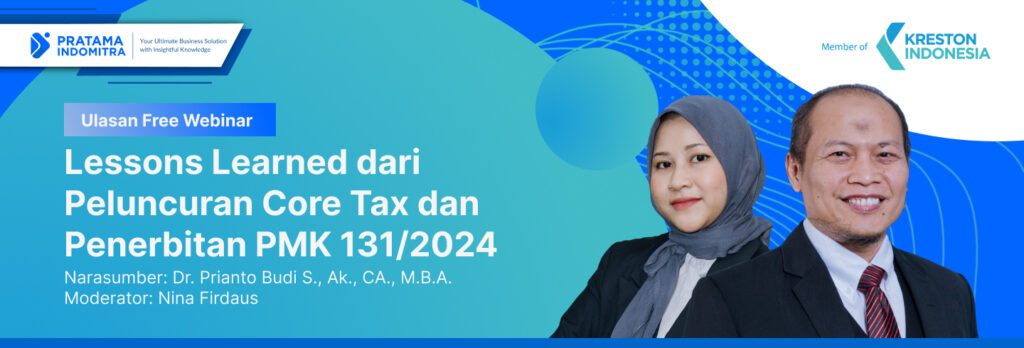
PT Pratama Indomitra Konsultan once again held the 182nd Free Webinar which thoroughly discussed valuable lessons learned from the launch of the Core Tax Administration System (CTAS) and the issuance of PMK 131/2024. CTAS has been effectively operating since January 1, 2025, while PMK 131/2024, which regulates the technicalities of the 12% VAT multi-tariff for luxury and general Taxable Goods (BKP), was officially issued on December 31, 2024. This webinar took place on Wednesday, January 8, 2025, with the main speaker being Dr. Prianto Budi Saptono, Ak., CA., MBA, a tax practitioner, academic, researcher, and CEO of PT Pratama Indomitra Konsultan.
In this session, Dr. Prianto provided a comprehensive explanation regarding the challenges faced by Taxpayers (WP) in accessing CTAS due to various technical constraints, while also offering practical solutions to overcome these problems. In addition, he also reviewed the multi-tariff VAT policy, especially for luxury and general Taxable Goods (BKP), and its implications for Taxpayers. This webinar was hosted by Ms. Nina Firdaus, S.Sn., who currently serves as staff in the Digital Content Division at PT Pratama Indomitra Konsultan.
Valuable Lessons from CTAS
Dr. Prianto opened the webinar discussion by providing a number of testimonials from Taxpayers and fellow tax consultant colleagues regarding the launch of CTAS. The majority responded to the launch of CTAS with complaints regarding the difficulty of accessing the tax administration system site portal. This is thought to be due to heavy traffic access and the tax portal has not been able to accommodate Taxpayer accessibility in a close or simultaneous time. Basically, this is natural because PMK-81/2024 emphasizes that all implementation of the fulfillment of Taxpayer rights and obligations is carried out electronically through CTAS, in accordance with Article 6 paragraph (1) of PMK-81/2024. There is no other media to implement Taxpayer rights and obligations other than through CTAS. Therefore, the surge in access from activities by all taxpayers allows the portal to experience heavy traffic access.
In addition to difficulties in accessibility, taxpayers also question several technical provisions that are not explicitly explained in PMK-81/2024, but are included in the process of fulfilling tax obligations through CTAS. One of these matters concerns the Taxpayer Account in CTAS (Taxpayer Account Management). Apart from these two main points, the rest of the taxpayers only question the readiness of CTAS in carrying out its function as an electronic-based tax administration tool.
After presenting various responses to the launch of CTAS, Dr. Prianto straightened out the issues with the analogy of a glass half filled with water/half not filled with water. He explained that the glass provides two opposing views. Some people think that the glass is half filled with water, but others explain that the glass is not half full.
Based on this analogy, it is known that humans as rational beings have different perceptions of a problem. Similar to CTAS which was recently launched, for taxpayers the tax portal adds to the administrative burden and time to learn from the beginning, not to mention accessibility constraints. However, for the Directorate General of Taxes, the launch of the tax portal is a significant advancement in the history of Indonesian taxation. Moreover, the issuance of CTAS is not only the will of the Directorate General of Taxes, but also follows the recommendations of the OECD.
CTAS in Indonesia is a representation of the OECD published book entitled “Tax Administration 3.0: The Digital Transformation of Tax Administration” in 2020. The launch of CTAS cannot be separated from the government’s efforts to increase tax revenues through the digitalization of the tax administration system, as well as following the development of the tax administration system globally. It is undeniable that CTAS has good intentions in the Indonesian tax administration system, but good is not enough.
Similar to humans who go through various stages in their lives, software products also have stages that are often referred to as the Software Release Life Cycle (SRLC). In this cycle, there are 6 stages that function as “development stages” of applications and their respective time periods. However, it is difficult to predict when one phase ends and another begins because each phase has a series of activities and requirements across different units and functions.
Based on the 6 stages of SLRC, as described above, every party directly related to CTAS can assess the launch of the tax portal at which stage it is. Pessimistic and optimistic perspectives always accompany the views of taxpayers towards CTAS when they find it difficult to interact with CTAS in early January 2025. However, the Directorate General of Taxes as the application developer has also responded to all complaints and criticisms until the term has been received by the DGT” delivered by one of the structural officials at the KPP.
VAT Policy in 2025
Dr. Prianto explained that the underlying concept of added value in the VAT system is related to the concept of added value according to the following five basic formulas:
Input + Process = Output
Output – Input = Process
Output – Input = value added
T(Output) – t(Input) = VAT
t(Output – Input) = VAT
According to Dr. Prianto, the basic concept of added value is depicted in formulas number one and two. Furthermore, t (tax) is added to formulas number four and five. PMK-131/2024 uses formula number four, the difference in VAT treatment since the issuance of the regulation lies in the amount of output. Before the issuance of PMK-131/2024, the amount of output was 100%, while since January 1, 2025 the output value has been 11/12. This means that even though the output has changed, the input remains the same. In the end, the output can be credited with the input.
In the fourth formulation, an indirect tax approach is used, namely Input Tax or t(Input)t(Input) can be credited as long as there is Output Tax or t(Output)t(Output). This is because in the value-added tax system, taxation is not carried out directly as seen in the fifth formula. This formula is applied to the treatment of VAT DPP with other values
In the fifth formulation, Input Tax t(Input) cannot be credited if there is no Output Tax t(Output), which is caused by two factors, first, the input is not processed into output; or second, the input has been processed into output, but does not produce Output Tax [t(Output)].
Regarding the regulation on VAT DPP with other values, Dr. Prianto said that the Directorate General of Taxes is preparing the latest policy to revise the Minister of Finance Regulation (PMK) which regulates the amount of other values. At the socialization event for the implementation of the 12% VAT increase, the Directorate General of Taxes submitted a list of provisions for VAT DPP with other values ??or certain amounts that will be adjusted to PMK-131/2024.
In closing, Dr. Prianto re-concluded the discussion of the 182nd edition of the webinar by explaining that information technology is important when running a business process, as is the taxation system in Indonesia. Although challenges often arise at the beginning of the implementation of CTAS, the application has the ultimate goal of reforming Indonesian taxation. Moreover, the Directorate General of Taxes issued PMK-131/2024 as an implementation of the 12% VAT rate with DPP 11/12, except for luxury goods.
Pratama Friends can download the materials and case studies of the 181st Free Webinar at the following link