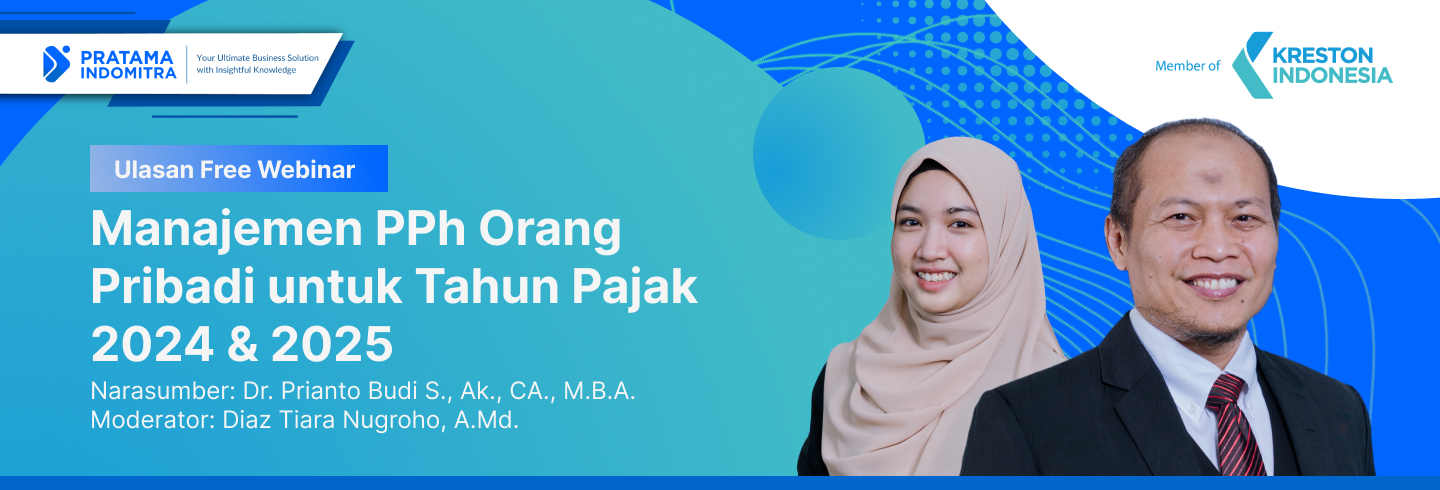



PT Pratama Indomitra Konsultan once again held the 188th Free Webinar which continued the discussion on Personal Income Tax management for the 2024 & 2025 Tax Years volume 2. This webinar took place on Wednesday, March 12, 2025, with the main speaker Dr. Prianto Budi Saptono, Ak., CA., M.B.A., a tax practitioner, academic, researcher, and CEO of PT Pratama Indomitra Konsultan. This webinar was moderated by Ms. Noor Salma S.I.A, who currently serves as staff in the Tax Assistance Division at PT Pratama Indomitra Konsultan
In this webinar session, Dr. Prianto explained a number of questions raised by the audience in the previous session. The majority of the audience asked about reporting the 2024 Personal Income Tax Annual Tax Return. The most common problem that arose was the difference between the SPT 1770, 1770 S, and 1770 SS forms. In fact, there are still many Taxpayers who are apparently confused in determining the form that suits their category. In addition, several audiences also asked about the SPT reporting mechanism for Micro, Small, and Medium Enterprises (MSMEs), who often face obstacles in understanding their tax obligations.
Based on the questions that arose, it is clear that the complexity of tax regulations in Indonesia is one of the main factors causing confusion which ultimately hinders the tax compliance expected by the government. Many Taxpayers experience “honest perplexity“, which is pure ignorance of the applicable rules. On the other hand, there are also Taxpayers who carry out “creative compliance”, which is in a condition where Taxpayers try to follow the rules textually, but do not fully understand the meaning behind the rules. This phenomenon is a challenge in itself in the tax system that leads to compliance.
In his book entitled “The Long Game: How Regulators and Companies Can Both Win”, Skidmore (2003) highlights that complexity is a characteristic of modern regulations. Regulations must be able to accommodate various goals and interests, both from the government and Taxpayers. As a result, every time there is a change or addition to the rules, the complexity faced by the regulated parties (regulatees) increases, causing confusion or even interpretations that are not in accordance with the spirit of the existing regulations.
Furthermore, Skidmore (2003) explains that the more detailed a regulation is, the greater the potential for two things to arise. First, honest confusion, which is a situation where someone really does not understand the applicable rules. Second, creative compliance, which is a condition where someone consciously interprets the rules in a way that benefits them, remains within legal limits but may not be in accordance with the main purpose of the regulation. This often occurs in taxation, namely when Taxpayers look for loopholes to minimize their tax obligations.
In the context of Indonesian taxation, these two phenomena are very relevant. Some Taxpayers are frustrated with complex rules so they don’t know where to start. Meanwhile, there are also those who try to understand the rules in their own way, often with the aim of paying as little tax as possible without actually breaking the law. This phenomenon poses a challenge for the tax authorities in ensuring proper compliance for all Taxpayers.
Dr. Prianto emphasized that the main solution to this problem is better education for Taxpayers. The government and tax authorities need to provide clearer and easier-to-understand guidelines, and improve access to tax information. With a better understanding, Taxpayers can carry out their obligations more smoothly without feeling burdened by the complexity of existing regulations.
In addition, Taxpayers are also encouraged to utilize various sources of information available, such as the official website of the Directorate General of Taxes (DGT), seminars, and tax consultation services. In this way, they can gain a better understanding of their tax obligations without having to rely on personal interpretations that could be wrong.
As a practical solution, Dr. Prianto suggested that Taxpayers can search for information using search engines such as Google. By typing in questions about taxes, they can find various sources that provide simple explanations of applicable tax regulations. However, he also reminded Taxpayers to remain careful in choosing sources of information and ensure that the references used come from credible sources.
In closing, Dr. Prianto emphasized the importance of tax awareness and education for the public. With a better understanding, Taxpayers can avoid unnecessary confusion and avoid potentially detrimental creative compliance.
Collaborative efforts between the government, information providers, and the public are needed to create a tax system that is more transparent and easy to understand for all parties.
Pratama Friends can download the materials and case studies of the 188th Free Webinar at the following link
https://drive.google.com/drive/folders/1QNXqJ2gw4VtryC7jNBrITzWJhI0n0tdc?usp=drive_link