


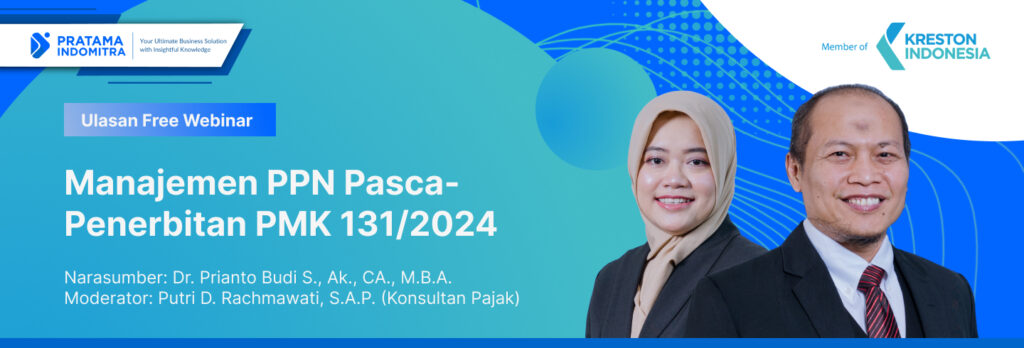
PT Pratama Indomitra Konsultan once again held the 183rd Free Webinar with the topic “Post-Issuance of PMK 131/2024 VAT Management”. This webinar took place on Wednesday, January 15, 2025, with the main speaker Dr. Prianto Budi Saptono, Ak., CA., M.B.A., a tax practitioner, academic, researcher, and CEO of PT Pratama Indomitra Konsultan
In this webinar session, Dr. Prianto explained that PMK 131/2024 regulates the imposition of VAT at a rate of 12% and a special DPP calculation scheme, as well as the possibility of issuing new regulations to expand the scope of taxation policies in accordance with the vision of fiscal reform. This webinar was moderated by Ms. Putri Dian Rahmawati, S.AP, senior staff of the Compliance Division at PT Pratama Indomitra Konsultan.
Dr. Prianto explained in detail how a regulation should be read, including PMK 131/2024. The first step is to pay attention to the titulus est lex or the title of the regulation. The regulation in question is entitled “Value Added Tax Treatment on Imports of Taxable Goods, Delivery of Taxable Goods, Delivery of Taxable Services, Utilization of Intangible Taxable Goods from Outside the Customs Area within the Customs Area and Utilization of Taxable Services from Outside the Region”, which means that this regulation only regulates 4 points as follows: a) Import of Taxable Goods (BKP); b) Delivery of Taxable Goods and Services (JKP); c) Utilization of Intangible BKP; and d) Utilization of JKP. Thus, all transactions outside of these four points are free from the provisions of PMK 131/2024.
The creation of the PMK cannot be separated from the ratio legis which can be seen in the considerations section, namely for reasons of justice in the application of VAT which is manifested in the application of other values ??as the Taxable Basis (DPP). Furthermore, Dr. Prianto said that the key to the regulation is stated in Article 2 paragraph 3. In essence, the policy regarding VAT which officially applies as of 2025 regulates the imposition of a 12% rate, with a difference in the imposition of DPP.
Basically, the Regulation of the Minister of Finance (PMK) is a regulation that regulates the technical-administrative aspects of a law, in accordance with the mandate of Law No. 12 of 2011. In the context of the implementation of Value Added Tax (PPN), PMK 131/2024 is one of the latest technical-administrative regulations issued. However, this PMK is not the only guideline in calculating VAT, but rather part of a broader regulatory framework. Dr. Prianto explained that the current VAT calculation framework is based on the theory of added value, which divides the calculation approach into two, namely output and input, as regulated in Article 4 of the VAT Law.
In the t(output) approach, VAT calculation includes five main schemes according to the tax object. In the leftmost chart, a 0% rate is applied to exports of Taxable Goods (BKP) and Taxable Services (JKP). A 12% rate is imposed on luxury goods, general goods, and other objects with a Taxable Base (DPP) in the form of other values. For DPP of other values, there are two main arrangements: first, on BKP/JKP regulated in PMK 131/2024, with a special calculation scheme, namely 12% x (11/12 x the selling price of BKP/JKP); second, on other objects regulated in nine different PMKs. The DPP scheme in these nine PMKs does not use the 11/12 calculation and generally applies to general or non-luxury goods.
According to Dr. Prianto’s prediction, the government will likely issue new regulations, either through a separate PMK or the Omnibus Law mechanism, to accommodate general goods not covered by PMK 131/2024. This step is considered important so that the calculation of VAT with a DPP of 11/12 can be applied more widely, in line with the spirit of tax policy reform promoted by the President of the Unitary State of the Republic of Indonesia, Mr. Prabowo Subianto. This approach not only strengthens the technical framework of VAT, but also reflects efforts to align fiscal policy with the vision of national development.
In closing, Dr. Prianto clearly explained the case study of VAT transactions that occurred between three parties, namely PT Pengusaha Dalam Kawasan Berikat (PT PDKB) in Bandung, PT Pengusaha Tempat Lain di Dalam Daerah Pabean (PT TLDDP) in Jakarta, and PT Pengusaha Dalam Kawasan Berikat (PT PDKB) in Semarang. In analyzing the transaction, the key word is that the three parties must agree that in the transaction, the delivery of BKP is carried out which is sent from PT PDKB in Bandung to PT PDKB in Semarang. In this case, it means that PT TLDDP orders PT PDKB Bandung to hand over goods to PT PDKB Semarang as the place of delivery (place of supplies). Thus, if an agreement has been formed between the three parties, the transaction does not violate regulations by exploiting regulatory loopholes. In other words, the sale of BKP by PT PDKB Bandung to PT TLDDP Jakarta is not subject to VAT because the delivery of BKP is made to PT PDKB Semarang as the place of supply, even though the BKP
ordered by PT TLDDP Jakarta.
Pratama Friends can download the materials and case studies of the 183rd Free Webinar at the following link